Language Learning | Jumpspeak
- 4.1
- Rating
- 500.00K
- Installs
- Free
- Price
 Analysis by App-foxy
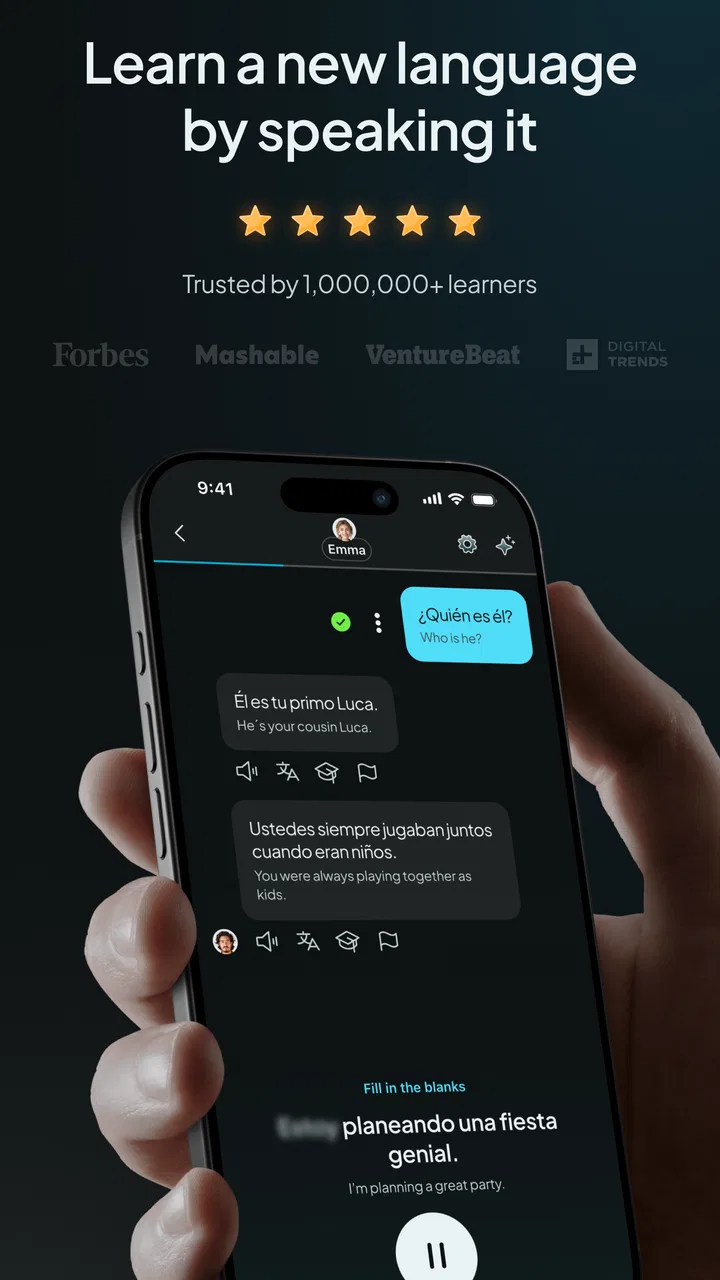
I approached Jumpspeak as a practical language-learning tool rather than another app to open once and forget. Its main promise is conversation practice supported by AI, with Spanish, French, German, and more than twenty other languages available. That makes the important question less about how many lessons it contains and more about whether its style fits the way you actually learn.
In my experience, the app is most interesting for people who understand that knowing vocabulary is not the same as being able to respond. It gives you a way to rehearse everyday language on a phone, which can feel less intimidating than speaking with a tutor or joining a class. At the same time, it is not a complete replacement for every kind of study. If you need careful grammar instruction, formal exam preparation, or a structured classroom path, you should judge it alongside more traditional alternatives.
What I looked for before recommending it
My first decision criterion was the amount of speaking a learner can realistically fit into an ordinary day. A language app can have attractive lessons and still fail if every session feels like paperwork. Jumpspeak makes sense when you want quick practice that resembles a conversation, especially during small gaps in your routine.
You May Also Like

 Blood Strike: 2.5 Anniversary
Blood Strike’s Loadouts Turn Every Drop Into a Tactical Gamble
A close look at Blood Strike’s custom loadouts: how fast access to signature weapons reshapes its battle royale rhythm, rewards preparation, and narrows the gap between fights.

 Pandora - Music & Podcasts
Pandora’s Music Is Easy to Start, but Harder to Recover
Pandora’s strength is its low-effort path from a seed to a station. Its weak spot is how much confidence it asks you to place in connection, setup, and quiet recovery.

 8 Ball Pool
 Is Built on Rivalries, Rematches, and Routine
A close look at the rivalries, rematches, shared routines, and unanswered safety questions that turn a quick pool match into a persistent mobile community.

 Samsung Music
’s Quiet Strength Is Playing What You Already Own
Its reach comes less from spectacle than from dependable access to a personal library. That simplicity is both the app’s strongest retention engine and its ceiling.

 AccuWeather: Weather Radar
AccuWeather Review: A Quick, Clear Forecast for Everyday Decisions
For everyday plans, the best forecast is the one you can understand quickly. AccuWeather makes rain timing, radar, and local conditions easy to act on, with a few trade-offs.

 Hill Climb Racing
Why Hill Climb Racing Still Turns Crashes Into One More Run
A tiny car, a bumpy hill and one more upgrade: Hill Climb Racing keeps resurfacing because its simple chaos makes every near-miss feel personal.
More From Our News Desk



The second criterion was usefulness outside the app. I wanted practice that could help with situations such as ordering food, greeting a colleague, asking for directions, or keeping a simple conversation moving. Memorizing isolated translations is useful at the beginning, but the real test is whether the words become available quickly enough when another person is waiting for an answer.
The third criterion was comfort. Speaking to an AI is not identical to speaking to a native speaker, but it can reduce the embarrassment that stops many beginners from practicing. I found this particularly relevant for learners who know basic phrases but freeze when they have to produce them aloud. Repetition in a private setting can build momentum before a real conversation.
I also considered the app’s place in a wider study routine. Jumpspeak is free to install, and the Android release supports devices using version 7.0 or later. The app has a 4.1 average from around 7.7 thousand ratings, with more than 500 thousand installs, so it has attracted a substantial audience without being something I would treat as a universal solution for every learner.
How the learning approach feels in daily use
The strongest part of the experience is the focus on active language. Instead of only reading a phrase and tapping a translation, I found myself thinking about what I would say next. That small change matters. Recognition is easy because the answer is in front of you; recall is harder, and recall is what you need when a waiter, neighbor, or coworker is speaking to you.
I recommend starting with one concrete situation rather than trying to cover everything at once. For example, if your goal is travel, spend a session working around greetings, transport, restaurants, and simple requests. If your goal is work, concentrate on introductions, scheduling, clarification, and polite disagreement. This approach makes the practice feel connected to a real need instead of becoming a collection of disconnected exercises.
A useful routine is to say your answer aloud even when the app does not force you to do so. I would first respond naturally, then repeat the phrase more slowly, and finally try it again without looking at the text. That three-step loop turns a passive session into speaking practice. It also exposes a weakness quickly: if you can recognize a phrase but cannot produce it without visual help, you have found exactly what deserves another round.
Another practical tip is to keep a small list of phrases that repeatedly slow you down. I would not write down every unfamiliar word. I would note expressions that are useful, easy to confuse, or difficult to pronounce. Returning to those phrases later is more valuable than collecting a long vocabulary list that never reaches active use.
Where the app wins over familiar alternatives
Compared with flashcard-only tools, Jumpspeak is better suited to learners who need help moving from knowing a word to using it. Flashcards are excellent for deliberate vocabulary review, and I would still use them for irregular verbs or specialized terminology. However, they rarely recreate the pressure of choosing a response while a conversation is moving forward.
Compared with a traditional course, the app is more flexible. A class may give you a clearer syllabus and the accountability of a teacher, but it also asks you to be available at a particular time. Jumpspeak fits more easily around commuting, childcare, shift work, or a busy study schedule. That convenience is not a minor benefit; regular short practice usually beats an ambitious plan that you abandon after a week.
It also has an advantage over jumping straight into conversations with strangers. Real interaction is essential eventually, but beginners may spend most of their energy worrying about mistakes. AI practice offers a lower-pressure rehearsal space. I would use it to prepare for real conversations, not to avoid them permanently.
The app’s language range is another reason it may appeal to curious learners. It covers Spanish, French, German, and over twenty additional languages, so it can be a useful starting point if your target language is not one of the usual choices in local classes. Still, availability alone does not tell you whether every language feels equally deep or equally suitable for an advanced learner, so I would test your chosen language before committing to a long routine.
A realistic everyday scenario
Imagine that you are preparing for a trip and have fifteen minutes before leaving for work. Instead of trying to complete a large lesson, you could practice a hotel check-in conversation, answer aloud, and repeat the phrases that feel unnatural. Later, you might use the same expressions while walking or waiting for transport. That is where I see the app fitting best: not as a single major study block, but as repeated preparation for situations you expect to face.
For a beginner, I would use the first session to discover which phrases feel immediately useful. During the next few sessions, I would revisit those phrases while changing small details, such as the day, location, or request. This prevents memorizing one rigid script. The goal is to learn a flexible pattern that can survive a slightly different question.
For an intermediate learner, the value is different. You may already know the grammar but hesitate during spontaneous speech. In that case, I would answer quickly first and correct myself afterward. Stopping after every mistake can make speech painfully slow. Fluency practice and accuracy practice are related, but they are not the same activity.
Important limitations before you switch
The conversational format can create a false sense of progress if you only repeat comfortable topics. I would deliberately choose prompts that make me explain, compare, or ask for clarification. Otherwise, it is easy to become good at familiar exchanges while remaining unprepared for unexpected replies.
AI feedback also deserves a realistic interpretation. It can encourage practice and help you notice patterns, but it should not be treated as the final authority on every nuance, accent, regional expression, or formal situation. If a phrase matters for a job interview, legal appointment, academic application, or sensitive conversation, I would verify it with a qualified teacher or reliable reference.
Another limitation is motivation. The app lowers the barrier to practice, but it cannot decide your goal for you. Learners who enjoy a textbook sequence, written exercises, and visible grammar progression may find a dedicated course more satisfying. Likewise, someone preparing for a standardized test will probably need materials designed around that exam rather than relying on conversation practice alone.
The free entry point is helpful, but the experience includes in-app purchases ranging from $12.99 to $499.99 per item. I would pay close attention to the purchase screen and the commitment involved before upgrading. The right question is not whether the app is inexpensive in isolation; it is whether you will use its speaking practice often enough to justify the cost compared with a book, class, tutor, or another app.
Who should use it, and who should choose something else
I think Jumpspeak is a strong fit for beginners who want to speak early, travelers who need practical phrases, and intermediate learners who understand more than they can say. It is also useful for people who avoid live practice because they feel self-conscious. A private rehearsal space can make the first step much easier.
I would be more cautious recommending it to learners who need a highly controlled curriculum. If you want every grammar point introduced in a fixed order, detailed written explanations, and extensive exercises with one correct answer, a conventional course may be the better foundation. The same applies if your main goal is reading technical material rather than participating in everyday conversation.
It may also be the wrong choice for someone who expects AI alone to produce fluency. Speaking ability grows through exposure, correction, listening, and real interaction. I would combine the app with authentic audio, some reading, and occasional conversations with people who use the language naturally. That combination covers weaknesses that no single mobile tool should be expected to solve.
The cost of changing your study routine
Switching to Jumpspeak is easy technically because it is a free Education app from Jumpspeak.com, and its content rating is Everyone. The harder part is changing how you study. If you currently use flashcards, do not discard them immediately. Keep them for words that require spaced review, while using Jumpspeak for producing those words in context.
If you attend a class, the app can work as preparation rather than competition. Practice a topic before class, then bring the questions and mistakes you noticed to your teacher. This makes classroom time more useful because you arrive with specific problems instead of waiting for the lesson to reveal them.
If you are replacing a tutor, be honest about what you are giving up. You may gain convenience and more frequent practice, but lose personalized correction and a human understanding of your goals. I would make the change only if scheduling or cost has made tutoring inconsistent. An app used frequently can be more valuable than a tutor you rarely manage to meet, but it is not automatically a deeper learning experience.
The current release is version 5.4.2, and the app has been available since December 17, 2020. Those details matter mainly because they show that this is an established product rather than a brand-new experiment. I would still keep the app updated and review my progress by asking a practical question: can I handle a slightly longer exchange now than I could before?
My recommendation after using it
My recommendation is straightforward: try Jumpspeak if your biggest language problem is hesitation. Its best quality is the way it encourages active responses in situations that feel closer to real conversation than ordinary vocabulary drills. I would begin with a specific goal, practice aloud, and measure progress by the situations I can handle rather than by the number of sessions completed.
I would not make it my only resource. Pairing it with listening from real speakers, reading suited to your level, and occasional human conversation gives the practice more depth. The app is particularly effective as the bridge between studying privately and speaking publicly.
Before paying, use the free starting point long enough to see whether you genuinely return to it. Check whether the available language and conversation style match your needs, and decide whether the purchase structure suits your budget. Since the app is aimed at Everyone, it can fit a broad range of learners, but age suitability does not guarantee that its method will suit every learning style.
For me, the final decision comes down to one distinction: do you need a complete academic course, or do you need more chances to say useful things in another language? If you need the former, choose a structured course and add speaking practice separately. If you need the latter, Jumpspeak is worth trying as a low-pressure daily speaking companion. Used with realistic expectations, it can turn the awkward gap between recognizing a phrase and actually saying it into the most productive part of your routine.
FAQs for Language Learning | Jumpspeak
01What is Language Learning | Jumpspeak?
Language Learning | Jumpspeak is a mobile language-learning app focused on helping users practice speaking through interactive lessons and conversational exercises. It is designed for learners who want to build confidence in everyday communication rather than study vocabulary and grammar only. The app generally combines guided practice, listening activities, repetition, and simulated conversations to create a more practical learning experience.
02Which languages can I learn with Jumpspeak?
Jumpspeak is primarily promoted as a tool for learning popular languages, although the exact selection may depend on the current version of the app and your device’s region. Before subscribing, check the in-app language list and course details carefully. This is especially important if you are looking for a less commonly taught language, a specific dialect, or advanced material beyond beginner and intermediate conversation practice.
03Is Jumpspeak suitable for complete beginners?
Yes, Jumpspeak can be useful for complete beginners because its lessons are structured around common phrases, practical situations, and gradual speaking practice. New learners can start with basic vocabulary and simple conversations before moving toward more challenging material. However, users who prefer detailed grammar explanations, writing exercises, or a traditional textbook-style course may need to combine the app with another learning resource.
04Does Jumpspeak use artificial intelligence or conversation practice?
Jumpspeak emphasizes interactive speaking practice and may use artificial intelligence or automated conversation features to simulate real-life dialogue, depending on the current app version. These tools can make practice feel more flexible and less intimidating than speaking with another person. Nevertheless, automated feedback is not always perfect, so learners should treat corrections as guidance and verify important grammar or pronunciation questions with reliable sources.
05Is Language Learning | Jumpspeak free to use?
You may be able to download Jumpspeak without paying, but access to the complete course, advanced lessons, conversation features, or additional learning tools may require a subscription or in-app purchase. Pricing, trial periods, and renewal terms can change, so review the payment screen before confirming. If you start a free trial, check the cancellation rules through the Google Play Store or Apple App Store.
Pros
- Short
- practical lessons fit easily into busy schedules.
- AI conversation practice helps build confidence before speaking with others.
- Covers useful everyday topics rather than only textbook phrases.
- Speech feedback can highlight pronunciation and fluency issues.
- Personalized practice keeps learning more engaging than static courses.
Cons
- Full access requires a subscription
- which may be expensive for casual learners.
- AI feedback is not always accurate with accents or unusual pronunciation.
- Some lessons may feel repetitive after extended use.
- It focuses mainly on speaking and may offer limited grammar depth.
- A stable internet connection may be needed for several features.

Language Learning | Jumpspeak
Gallery